|
||
14. An Ungrouped Iron - Elton |
| Listing of Structures |
| Back...Next |
| Meteorite - Elton, ungrouped iron |
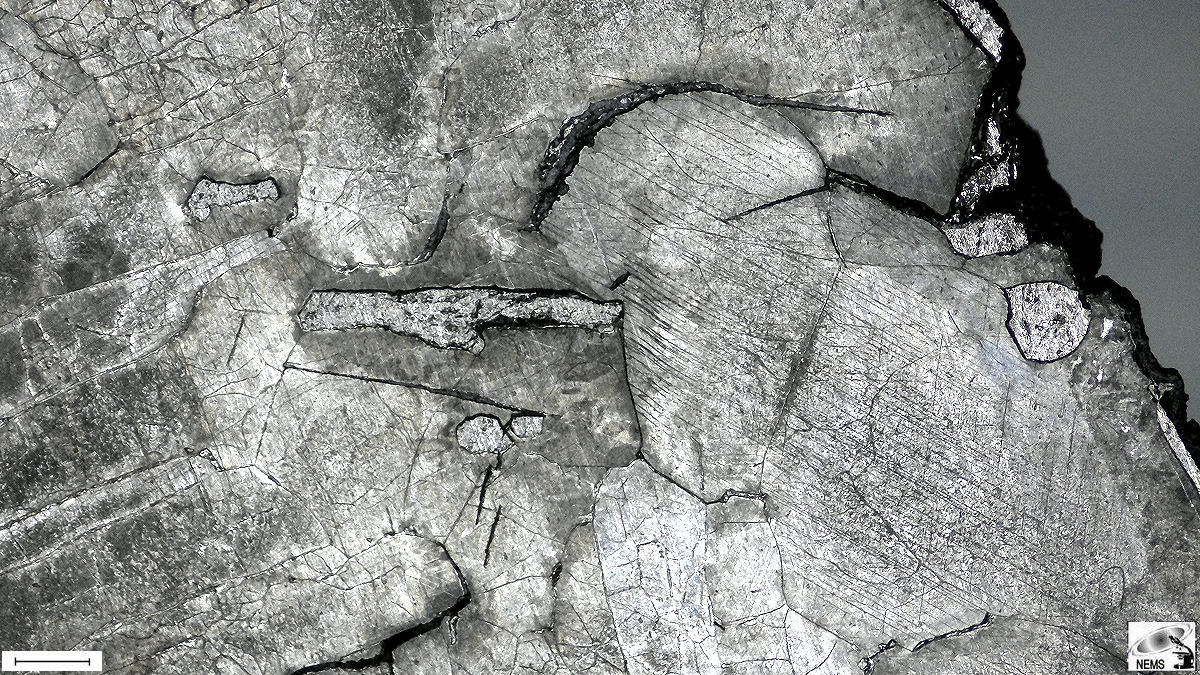 |
| Figure 1. Scale bar 700 µm. |
| The Elton iron meteorite, partially recrystallized kamacite, distorted Neumann lines (plus cross-hatched), partially visible Widmanstatten lamellae, and schreibersite. |
The Elton Iron Meteorite The Elton meteorite is an ungrouped iron recovered in 1936 or 1937 from a cultivated field on the farm of Mr. E. T. Varnell, approximately 8 km east-northeast of the Elton Post Office in Dickens County, Texas. It is likely associated with a witnessed fall in the area in early summer 1933. The specimen, weighing ~1.973 kg initially, showed only slight weathering and was recognized as a meteorite in 1938 by Glen Evans. Limited published data exist on Elton. Key references include an abstract by Elbert A. King, metallographic notes by Buchwald (1975) describing troilite-schreibersite rosettes, and trace-element chemistry suggesting possible affinities with IIB irons. Chemical Composition and Structure Chemical analysis of the metal yielded (wt%): Fe 91.6, Ni 6.9, Co 0.34, with minor elements. The meteorite is described as a medium to coarse octahedrite, with kamacite lamellae ranging from 0.5 to >1.5 mm. It contains large troilite inclusions with swathing kamacite rims and abundant schreibersite. Metallographic examination reveals a complex history of primary and secondary structures (Figures 1–4), including remnants of Widmanstätten pattern, Neumann lines, partial recrystallization of kamacite, distortion and cross-hatching of Neumann bands, net and comb plessite fields, and oriented skeletal schreibersite crystals. The Vickers microhardness of kamacite (280 ± 15) is consistent with moderate work-hardening or shock effects. Classification of Iron Meteorites and the Significance of Ungrouped Irons Classification systems in meteoritics organize the more than 74,000 registered meteorites according to chemistry, mineralogy, texture, and isotopic signatures, providing essential frameworks for understanding parent-body processes, differentiation, and solar system evolution. Among the approximately 1,300 known iron meteorites, 13 major chemical groups account for the majority; these are generally interpreted as core material from distinct differentiated asteroidal parent bodies that underwent fractional crystallization. However, roughly 152 irons (~11–12%) remain ungrouped. These “ungrouped” irons exhibit unique chemical and/or structural characteristics that preclude assignment to established groups. Their diversity likely reflects a variety of origins, including sampling of small, isolated parent bodies, atypical nebular conditions, or extensive secondary processing such as impact-induced shock metamorphism. Broader Context and Research Needs Elton’s possible IIB affinity, combined with its anomalous structural complexity, highlights the challenges in classifying ungrouped irons. Comprehensive modern studies—integrating high-precision ICP-MS geochemistry, electron backscatter diffraction (EBSD), and isotopic analyses—would better constrain its relationships. |
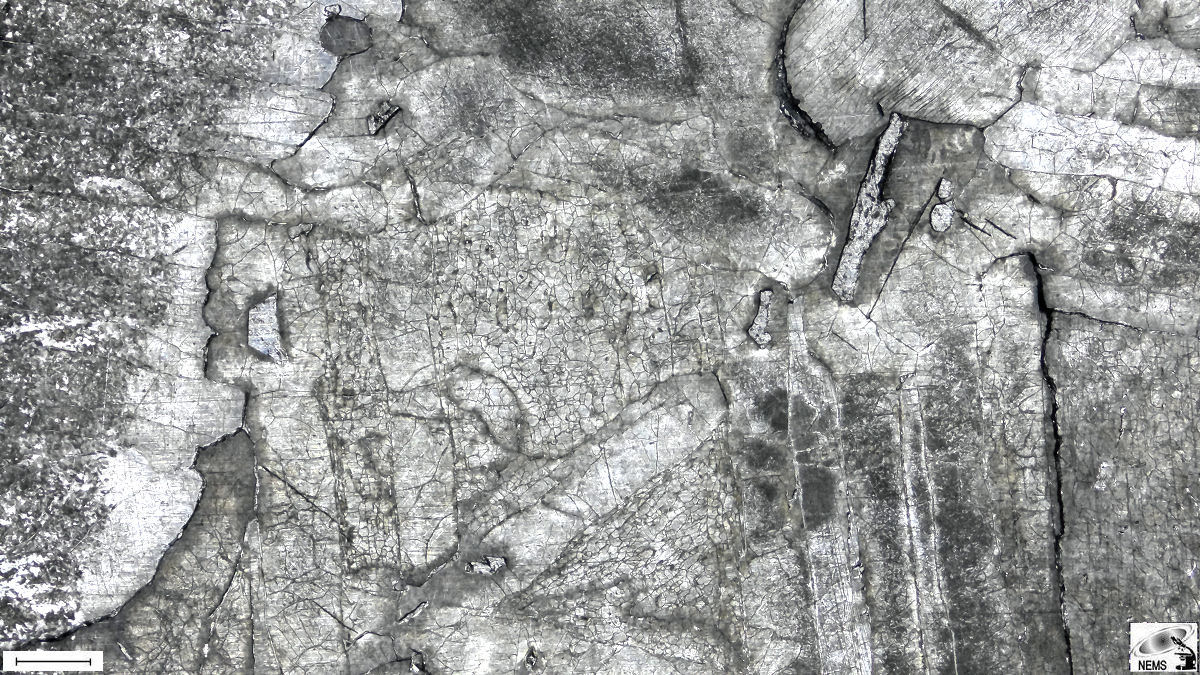
| Figure 2. Scale bar 1.3 mm. |
| Elton, altered structures. Partially recrystallized kamacite (left). Net plessite field nucleated with taenite (center). |
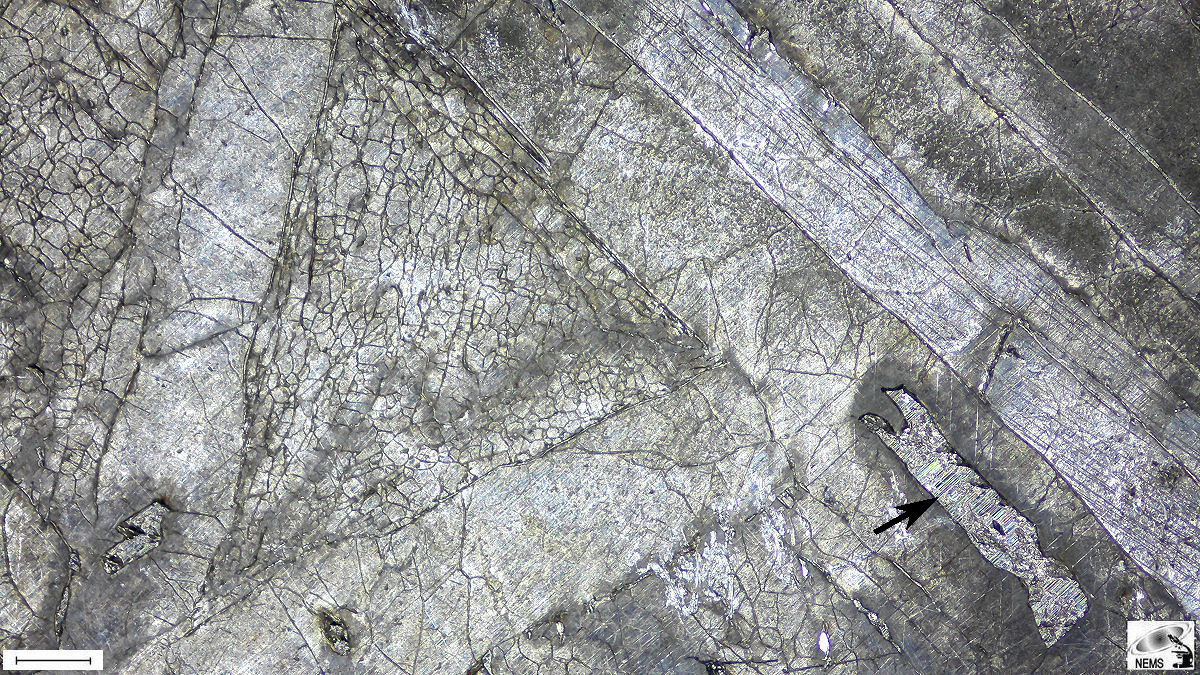
| Figure 3. Scale bar 1 mm. |
| Altered comb and net plessite field, center. Oriented skeleton schreibersite crystal, right. |
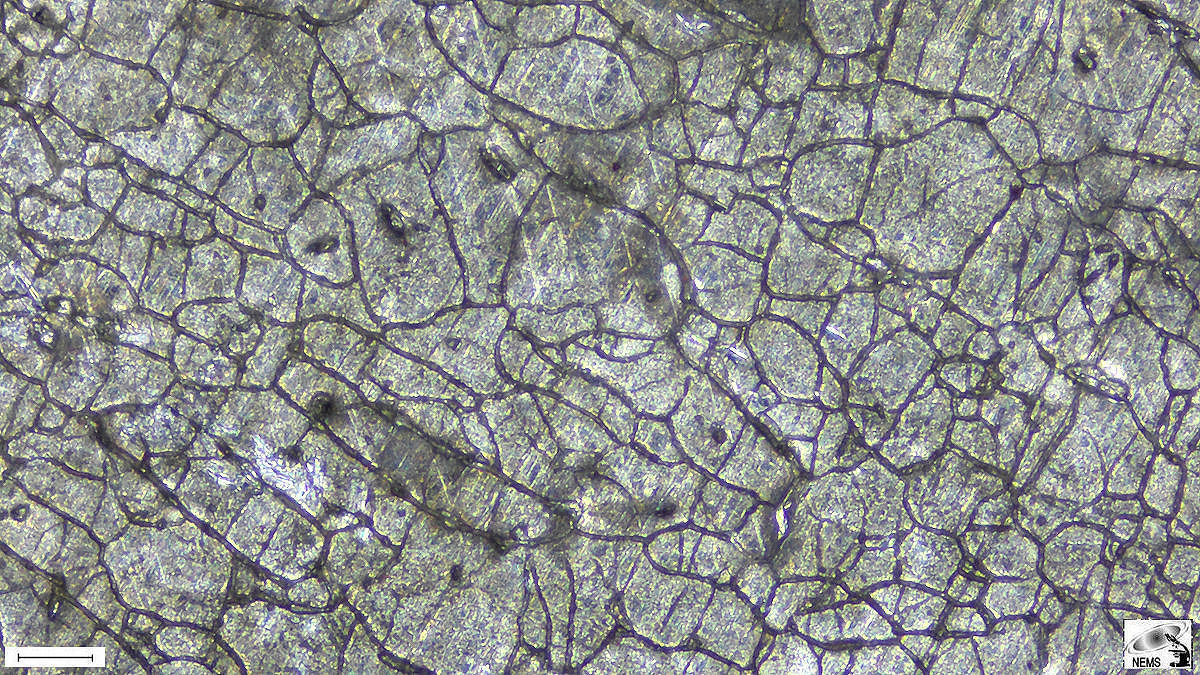
| Figure 4. Scale bar 80 µm |
| Net plessite field nucleated with taenite grains. |
| References • Buchwald, V. F. (1975). Handbook of Iron Meteorites. University of California Press (primary metallographic description and figures for Elton). • Meteoritical Bulletin Database (LPI). Entry for Elton (classification, recovery history, and references). • Wasson, J. T. (personal communication noted in literature; trace-element data suggesting IIB affinities). • Goldstein, J. I., et al. (2009). Iron meteorites: Crystallization, thermal history, parent bodies. Chemie der Erde, 69(4), 293–325 (context for plessite, recrystallization, and shock features in irons). • King, E. A. (abstract on Elton; University of Houston). • Scott, E. R. D., & Wasson, J. T. (reviews of iron meteorite groups and ungrouped specimens). |
| Listing of Structures |